

 Tyler McFarland on January 3, 2020
Updated on November 8, 2023 Reviewed and fact-checked Found a mistake? Let us know!
When you’re going plant-based and trying new vegan foods, you may have questions about which ones are safe to share with your dog. Well, I’ve been vegan for twelve years and have had a dog for two—so I’m probably one of the best people to show you the ropes!
Below, I’ll cover the vegan ingredients NOT to feed to your dog, and then I’ll dive into a bunch of these common questions about which vegan/health foods should be off-limits for your pet!
Note: I am not a veterinarian or any kind of dog/pet professional—but I’ll cite more sources along the way to help you sort through the best info online.
Which Vegan Ingredients Are Toxic to Dogs?

We’ve all probably heard that chocolate is bad for dogs. Maybe you’ve heard of other ones, too, like grapes or onions. Well, let’s start with a full list of those harmful foods.
With most of the following foods, it’s not like one crumb will kill your dog. Small dogs will often be more sensitive to small amounts, whereas big dogs can sometimes tolerate more. But my sense is that it’s best to completely avoid all of these foods.
Below is a full table of harmful foods, and this Healthline article includes more details and primary sources if needed.
| Vegan Ingredient | How It Harms Dogs |
| Grapes and Raisins | Can lead to rapid kidney failure and potentially death, even in small amounts. |
| Chocolate (dark chocolate is worst) | Can lead to heart attacks, internal bleeding, and death if severe. |
| Avocados | Can lead to fluid buildup in the lungs and chest, causing various complications and potentially death. |
| Xylitol (an artificial sweetener) | Can lead to a rapid drop in blood sugar and potentially liver failure and death. |
| Caffeine | Can lead to abnormal heart rhythms and lung failure, potentially death. |
| Alcohol | Can lead to lung failure, seizures, coma, and death. |
| Active Yeast (in raw dough) | Can lead to severe bloating and potentially alcohol poisoning and death. |
| Salt (in large enough amounts) | Can lead to water deprivation, fever, tremors, other complications, and potentially death. |
| Macadamia Nuts | Can lead to weakness, vomiting, and tremors. |
| Onions, Garlic, and Chives | Can lead to hemolytic anemia and other problems. |
| Apples, Apricots, Cherries, Peaches, Plums | Can lead to digestive problems via cyanide poisoning from the seeds/pits. |
Note: Milk and dairy products also cause digestive problems for many dogs due to lactose intolerance. But since it’s not vegan, I didn’t include it in the table.
Common Dog Allergies to Food
Keep in mind that many dogs also have food allergies or sensitivities that can also affect them negatively. These are also worth keeping in mind, beyond the toxic foods listed above.
According to WedMD, these are the most common food allergies for dogs (vegan foods are bolded): “beef, dairy, wheat, egg, chicken, lamb, soy, pork, rabbit, and fish.”
So, as we address a bunch of the vegan foods listed below, you’ll want to keep in mind that wheat and soy are problematic for some dogs but not all dogs.
Food allergy symptoms are usually something like the following: chronic ear inflammation, gastrointestinal problems, chronic diarrhea, chronic gas, licking their feet, or itchy rear end. (source)
Side Note: This is the best free video introduction I’ve found on adopting a plant-based diet—the right way. You’ll learn how to lower your risk of cancer, heart disease, type-2 diabetes, Alzheimer’s, and obesity—all with plants. Watch the free Masterclass here.
Can Dogs Eat Tofu?
Dogs can indeed eat tofu. However, it is not recommended as their main protein source, as it does not contain all their essential amino acids. Tofu can also cause problems for some dogs due to soy allergies or gas.
I’ve given my dog little bits of scrambled tofu before. (I don’t include onions in my scrambled tofu—again, onions are bad for dogs.) My dog seemed to like the tofu, and it didn’t cause any problems.
Soybeans are a type of bean, of course. And beans, well, they can give you gas—and that applies for your dog, too.
But personally, I’ve found that tofu gives me much less gas than whole beans, as it doesn’t contain nearly as much fiber. (Read my guide to stop vegan farting for more on the relationship between fiber and gas—it’s really interesting actually how it works.)
So what I’m saying is—I personally don’t think that your dog getting horrible gas from some scraps of tofu is very likely, unless they have an allergy. It’s just something to keep an eye on.
Can Dogs Eat Tempeh?

Tempeh is generally safe for dogs. However, there is a potential risk for allergies whenever feeding your dog soy, and it is not a complete protein for dogs. That said, tempeh in moderation should be fine and healthy for your dog.
Again, I’d start by only feeding my dog little scraps of tempeh. And I wouldn’t rely on it to replace her overall dog food, as it is not specially formulated to fit her nutrient needs. (Also that could get expensive!)
But yes, it should be safe to share some tempeh with your dog!
Can Dogs Eat Vegan Bacon?
Dogs can eat vegan bacon, but I would not recommend feeding them large amounts regularly. Although there are no acutely toxic ingredients for dogs in veggie bacon, it is often quite high in sodium, which can lead to problems. In addition, it is generally not formulated to meet the nutritional needs of dogs.
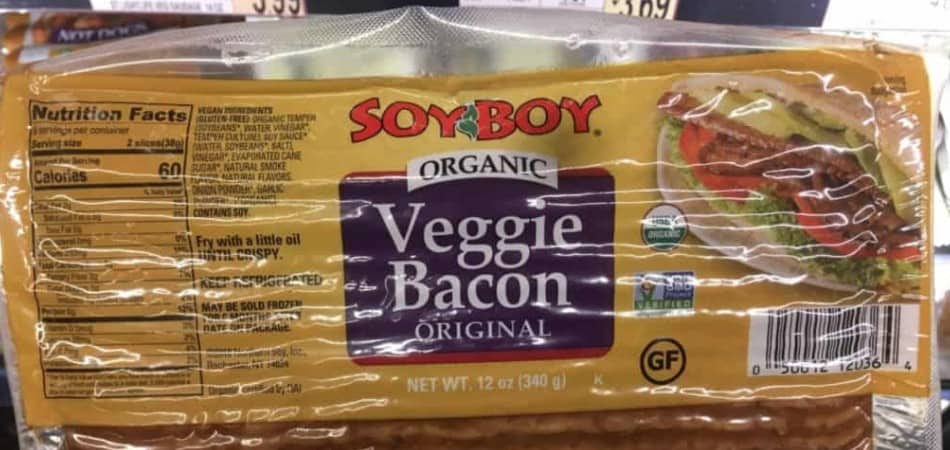
I included veggie bacon in this section because it’s often made of tempeh. But even if your veggie bacon is made out of seitan, soy isolate protein, or something else, the answer is likely about the same.
With most of these vegan specialty foods, just recognize they are not intended to be dog food, so don’t go overboard.
Can Dogs Eat Seitan?
Seitan is generally safe for dogs. However, some dogs have an allergy or sensitivity to wheat, which is present in seitan. The levels of sodium in seitan are also higher than recommended for dogs, so you should not feed them too much or as a consistent replacement for dog food.
If you want more info about dogs and wheat, check out this post from PetMD. It explains that, for most dogs, there is absolutely no need to cut out gluten or wheat, despite its sketchy reputation in recent public discourse.
You can even make your own seitan at home, which means seitan can be one of the cheapest and potentially more natural, simple mock meats available for you and/or your dog.
Can Dogs Eat Nutritional Yeast?
Dogs can eat nutritional yeast. Some dog health sources even recommend it as a supplement for the B vitamins it contains. Active yeast (and raw dough) should not be fed to dogs, but since nutritional yeast is an inactive yeast, it is healthy and should not cause problems.

I’ve heard that dogs love if you just sprinkle nutritional yeast on their food. Personally, I haven’t tried this because nutritional yeast is expensive, and my dog already likes her food!
But as mentioned above, I have given my dog pieces of scrambled tofu, which I season heavily with nutritional yeast. She liked it, and it didn’t cause any problems.
In fact, there’s a classic book on natural health for dogs and cats by Dr. Richard Pitcairn (Amazon link for the book), and it recommends adding nutritional yeast to your dog’s diet as a supplement!
Keep portion size in mind for nutritional yeast. Aside from the cost, it may have unexpected health effects in large doses. In humans, I know there are concerns about urea/gout when eating too much nooch.
There has also been some detected lead levels in certain brands of nutritional yeast. However, the amount is very low, so it should not be a problem at the levels most people (and dogs) are eating nooch (a few tablespoons at a time or less).
Can Dogs Eat Veggie Burgers?
Dogs can usually tolerate veggie burgers, but it’s not recommended in large quantities or as a regular meal. Some veggie burgers contain onion and garlic, which are toxic ingredients for dogs. Veggie burgers containing soy or cheese may also cause allergies or digestive problems for dogs.
In the book by Dr. Pitcairn (Amazon link) on natural health for dogs, he says that a veggie burger can be a good occasional meal or snack. But let’s address this concern about onions and garlic.
Remember that onions and garlic are toxic to dogs, causing their bodies to attack their own red blood cells. This can lead to anemia. So if you see “onion” or “garlic” in the ingredients list, it’s probably best to just not feed it to your dog.
Will you realistically reach toxic levels of onion or garlic in a single veggie burger? I feel pretty confident saying no… But why take the chance?
According to the American Kennel Club, it takes a full medium-sized onion to cause toxic effects in a 45-pound dog. And their article on garlic reports that it’d take about 2 to 10 garlic cloves to cause toxic effects for most dogs. But they also note that onion and garlic powder can be more toxic than fresh.
So it’s probably best to avoid any onion and garlic when you know it to be present in a given food, including burgers.
Can Dogs Eat Boca Burgers?
It’s not recommended to feed your dog Boca Burgers, due to the ingredients containing a small amount of onion. Onion and garlic can be toxic for dogs, potentially leading to anemia. Some dogs are also allergic to the soy in Boca Burgers.
Realistically, the amount of onion in a Boca Burger may not be likely to cause any problems. But most dog owners would agree, it’s better to be on the safe side.
Can Dogs Eat Veggie Hot Dogs?
It is not recommended to feed your dog veggie hot dogs in significant quantities. Most veggie dogs contain a small amount of onion or garlic, which are harmful to dogs. Vegan hot dogs made from soy may also cause allergies or gas for some dogs.
I looked up the ingredients for several common veggie hot dogs to see if they contained onion or garlic. Here’s what I found for each:
| Veggie Hot Dog | Onion or Garlic? |
| Yves Veggie Dogs | Contains dehydrated onion. |
| Yves The Good Dog | No Onion or Garlic listed. (But contains “spices.”) |
| Yves Jumbo Dogs | No Onion or Garlic listed. (But contains “spices.”) |
| Lightlife Tofu Pups | No Onion or Garlic listed. (But contains “Natural Flavors from Vegetable Sources.”) |
| Lightlife Smart Dogs | Contains dried garlic. |
| Tofurky Jumbo Hot Dogs | Contains onion powder. |
| Field Roast Frankfurters | Contains onions and garlic. |
Note: I did my best constructing this table from ingredients lists, but I don’t have inside knowledge about what the vague “spices” or “natural flavors from vegetables” contain.
As mentioned above with veggie burgers, I’m not saying the amount of onion or garlic found in a veggie hot dog will actually cause problems for your dog. My best guess is that it wouldn’t be an issue. But I personally wouldn’t knowingly feed my dog any garlic or onion, knowing that it’s harmful.
Aside from the garlic and onion, veggie hot dogs just seem quite processed. Even for the ones without garlic or onions, I wouldn’t recommend them as a regular meal for your dog.
I would think these points also apply to vegan sausages, by the way!
Can Dogs Eat Beyond Meat?
Dogs can generally eat Beyond Meat safely, but it’s not recommended as a regular meal or replacement for dog food. It is not formulated to meet the nutritional needs of dogs, and the sodium content specifically may be higher than ideal for dogs.
Judging from the Beyond Meat ingredients lists I’ve read on several of their products, I didn’t see any onion or garlic listed.

So I don’t think garlic or onion will be a problem with sharing Beyond Meat with your pup. But it may be worth checking the ingredients on the specific product you have!<